

Guide to Building Permit Application
Construction projects on private property require a building permit to be issued before any work begins. In this article, we are going to talk about the important steps you should take before starting any building or renovation project to prevent problems, unforeseen costs and delays along the way.
Contact your local government
You need to make sure that your proposed building or renovation will meet zoning and building requirements.
Do I have the right zoning?
It’s important that your building or renovation project meets the local zoning requirements. Local governments use zoning bylaws to regulate how a property can be used.
You will also need to ask your local government’s building department the following questions:
- What’s the current zoning on my land?
- Is my proposed building or renovation project permitted?
- What are the details of the current or proposed zone I want to build within?
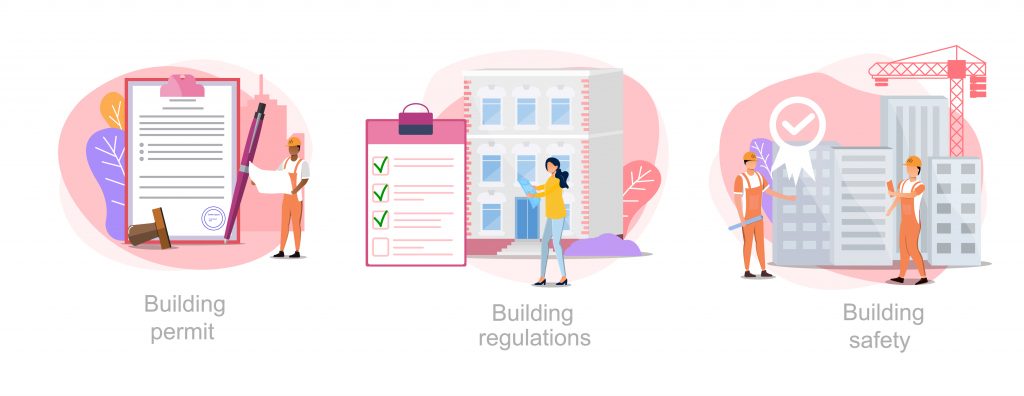
Obtain permits from your local government
Determine if you need a Development Permit
A separate development permit may be required before a building permit application can be submitted. This is in the case of large scale projects where zoning relaxations or particular types of land uses are proposed.
Development is “any change in the use of any land or building or the carrying out of any construction, engineering, or other operation in, on, over, or under land or land covered by water”. Development applies to both construction/ renovation and changing the use of a building or part of a building and is regulated by the Zoning and Development By-law.
If you are unsure on whether your project requires a separate development permit, contact your local Development and Building Services Centre.
Apply for a Building permit
Building permits are required for any new construction, alteration or addition to an existing building. Permits help ensure that construction and major renovations comply with local bylaws, the building code and health and safety standards.
Typically, permits required for new construction projects or major renovations fall under broad categories including building, demolition and plumbing. Electric, gas and sewage disposal work require separate permits and inspections. In general, the BC Safety Authority issues electrical and gas permits. Some local governments issue these permits.
Likewise, making any major changes that alter the footprint of your home requires a permit including additions, decks, certain fences, certain plumbing and electrical work, as well as siding projects. Failure to obtain permits even if you hire a contractor can delay your project or complicate the sale of your property.
Why get a Building Permit before starting your project?
It is important to get a Building Permit beforehand to:
- Protect the safety of occupants,
- Ensure you won’t have to tear your work down and start over with the required permits,
- Avoid additional permits and fees incurred if you build without a permit,
- Reassure buyers who avoid purchasing buildings with unauthorized construction,
- Maintain the value of your home,
- Ensure any new buildings and structures comply with all building regulations including the Building and Plumbing Bylaw, the BC Building Code and Zoning Bylaw regulations, and
- Allow your future business tenants to get a business licence, and keeps your insurance agent and neighbours happy.
What needs a Building Permit in BC?
Generally. a building permit is required before commencing:
- Site excavation or blasting
- Construction, repairing or altering a building or structure
- Moving a building
- Changing an occupancy
- Installation of any plumbing
- Construction of a masonry fireplace or installation of a solid fuel burning appliance or factory/masonry chimney
- Installation of an oil burning appliance or oil tank
- Demolishing, deconstructing or removal of a building
- Changing the land use of an existing commercial space
- Adding a secondary suite to an existing house
- Renovation projects that include moving interior walls and/or existing plumbing, electrical, or gas lines
- Structural repairs
- Drywall repairs to fire separations in multi-unit residential buildings
- Building or altering a garage, shed, or deck
- Renovating or tenant improvements for a new or existing commercial space
It’s crucial to know that you cannot start any stage of a project, including demolition or excavation until a building permit has been obtained.
On a different note, a building permit is not required for:
- Minor repairs or alterations to non-structural components of the building
- When a valve, faucet, fixture or service water heater is repaired or replaced, stoppage cleared, or a leak repaired if no change to the piping is required
- For an accessory building less than 10m2 that is used for utility purposes that does not create a hazard
- Retaining structures less than 1.2 meters in height
- Other retaining structures more than 1.2 meters in height and greater than 30o off vertical
However, if you are unsure whether your project will require a permit, call the Building Inspection office in your area.
How do I apply for a Building Permit?
Before applying for a building permit make sure your project meets the following requirements:
- You are the registered owner of the property or have permission to act on the owner’s behalf
- Property has the correct zoning
- Property is registered at the Land Title Office
- Property is accessible by an approved access/driveway
- Essential services have or will be provided for
- Building plans conform to current building, land use and zoning bylaws and all other applicable enactments
- Property address has been assigned
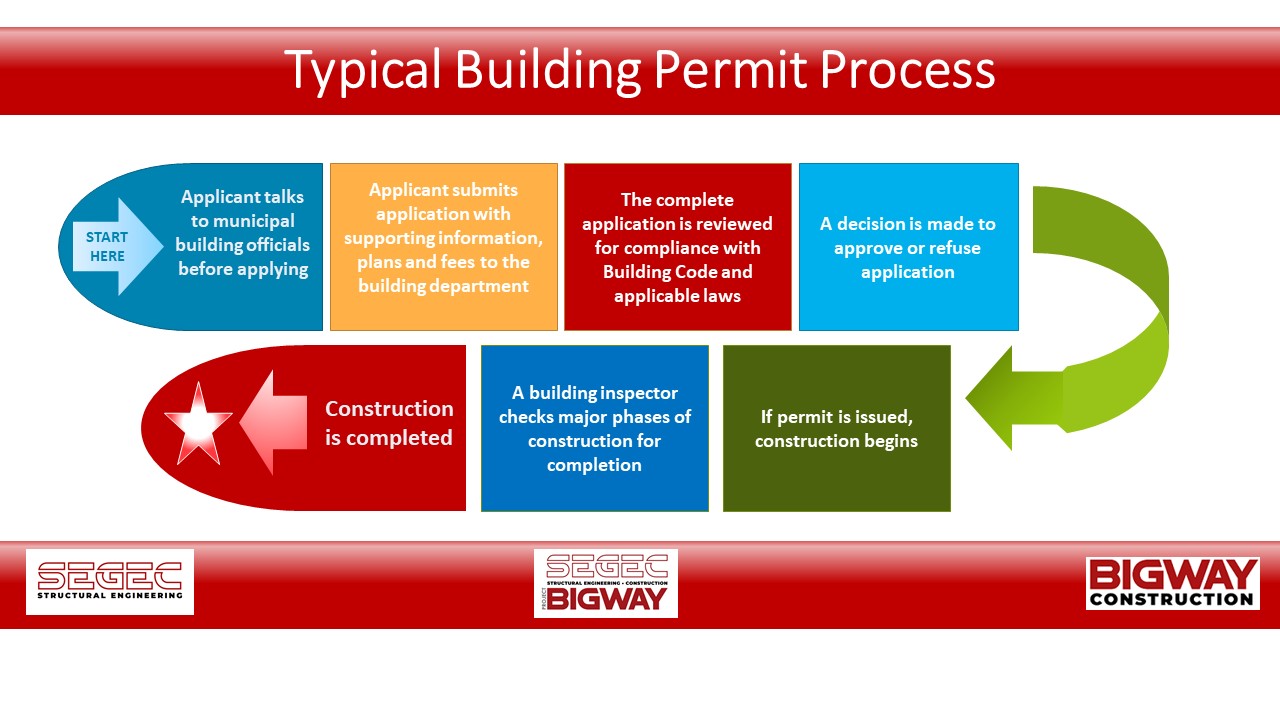
1. Submit completed application forms together with the supporting documents and pay the required plan processing fees.
You can either apply in person or submit your application through the mail.
Supporting Documents Required
Generally, you will need to submit the following documents with your permit application:
- Building permit application – completed form, signed and dated
- Plan processing fee
- Planning Department Approval
- Other Relevant Approvals from Authorities Having Jurisdiction
- Geotechnical Report
- Site Services and Grading Plan approved by the local public works department
- Demolition Drawings
- Structural Drawings and Calculations
- Architectural Floor Plans
- Building Elevations
- Mechanical Drawings
- Electrical Drawings
- Plumbing Line Drawings
- Technical Specifications
- Title 24 Compliance Forms
- Title 24 Disabilities Access Compliance
You must provide multiple copies of your plans in your application package. Plans must be drawn to scale. They must be clear, legible and indicate the nature of the work. Mirror image drawings will not be accepted.
- Building permit application – completed form, signed and dated
- Plan processing fee
- Plans to include foundation plan, floor plan (indicating room use), elevations (all sides of the building) and sections showing all structural details and finishes
- Site plan, complete with front, rear and side setbacks, distances to any adjacent watercourse, location of septic field and all buildings located on property
Further details on permit requirements and application forms are found on the links provided below:
Building Permit Application checklist
Permit Requirements & Checklists
How long will it take to process a permit application?
The average processing time for building permits is 14-21 days when all of the required documents have been submitted along with the application. However, processing time may still vary per city which can be shorter or longer than the average days mentioned above. In cases where outside agency approval is required the processing time may take longer.
How much will the permit or permits cost?
A plan processing fee is paid at the time the application is submitted. Fees vary per city but are usually based on the value of the construction project. In the event that the building permit is not issued within six months of receipt of the application, the building permit application will be cancelled and plan processing fee forfeited.
2. Application review
Upon submission, the permit application undergoes plan checks at various divisions of the building department. After the city’s review, a list of plan check comments will be generated. Your engineer will review them and respond to the city’s questions and action items.
If the documents follow their respective codes, you may get the permit after the first review. This seldom happens. Most permit applications go through at least one revision cycle. To hasten the process, it’s best to reduce the number of revisions by submitting detailed, compliant drawings and specifications.
3. Begin your construction, get trade permits, request and book inspections.
Once your building permit has been issued, you can begin work and get the required trade permits and book inspections. It is important that you start work on your project within six months from the date of when your permit was issued; otherwise, your permit will become void.
All work completed will need to be inspected at various stages of construction.
4. Occupy the building
You may require an occupancy permit to occupy the space in the building. When a final inspection has been passed, the work under the building permit is considered complete.
The following diagram is a general guide that outlines the most common process for a building permit review, and certain municipalities may have additional or different steps.
Risks of working without a permit
If you or your contractor do not have a permit for work that has already started, and it turns out you need a permit for that work, you could face serious – and potentially costly – consequences, including:
- A “work without permit” penalty which is typically double the original permit fee.
- A delay while your permit application is processed. All work must stop during this time and the original timeline and fees to process an application still apply.
- A potential to remove work that was already commenced prior to obtaining a permit
- A potential to do more work than you had originally planned and budgeted for, such as adding fire sprinklers or making seismic upgrades
- Potential for future legal and/or financial issues when selling your property or filing an insurance claim
As the property owner, you are responsible for paying these fees or penalties yourself even if you have hired a contractor who assured you that permits were not needed.
Seek advice from experts
If the scope of your proposed building or renovation project is outside your expertise, consider talking to a range of professionals in your area who can provide advice. These include general contractors, architects, engineers, electricians and plumbers.
Southeast Gateway Engineering and Construction Corp. provides comprehensive engineering services for diverse structures at different stages of the project’s life cycle. We can assist you with building permit applications and processing. Let us discuss your project.
BOOK your FREE INITIAL CONSULTATION with us NOW!
Fill in the contact form below.
You can also find our list of offered services HERE.


Have a question? Let's talk
Complimentary initial consultation
Send us a quick request and we will contact you to schedule a complimentary initial consultation.